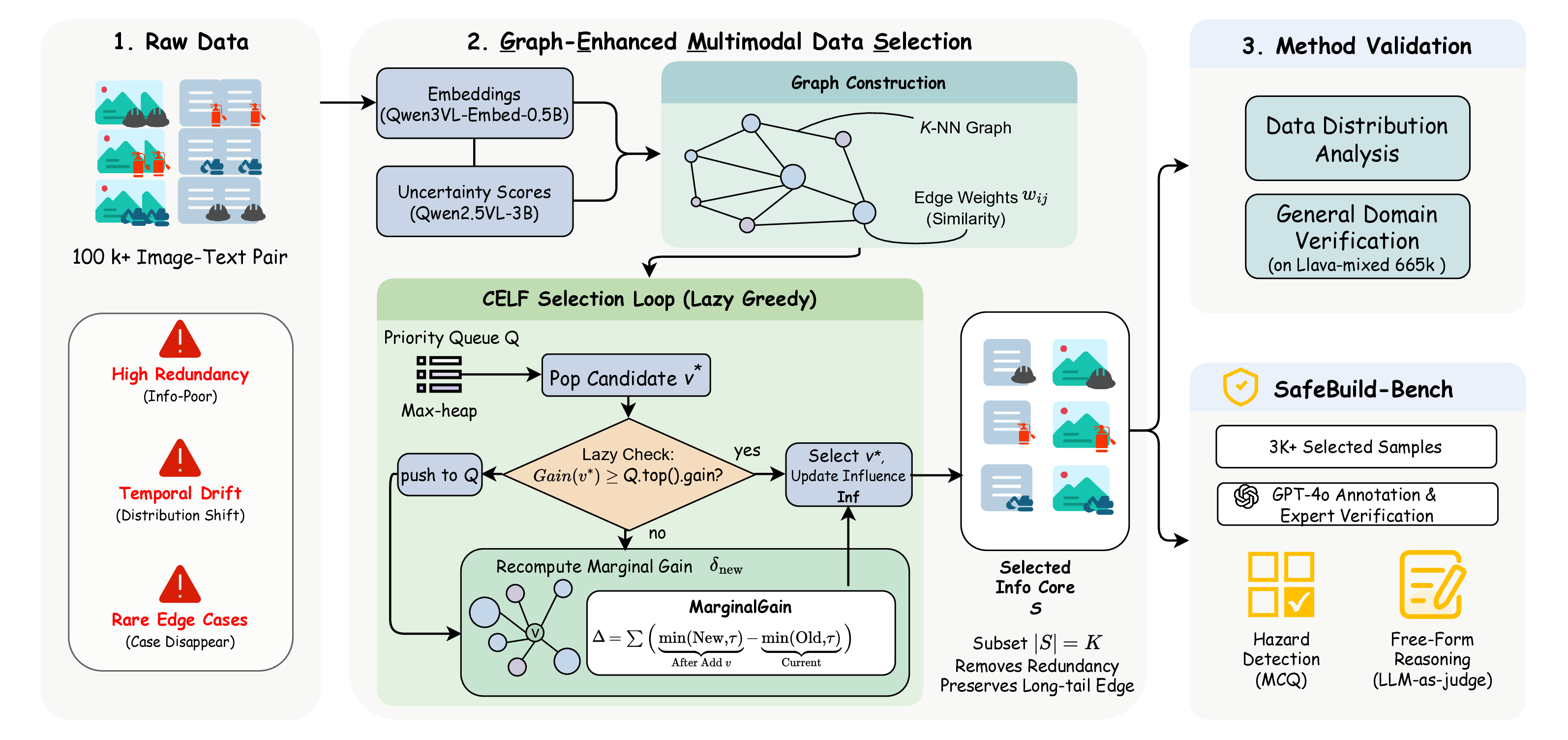
Graph Construction
Fuse image-text records into multimodal embeddings and connect nearby scenes through a sparse k-NN graph.
ACM SIGKDD 2026 · Jeju Island, Korea
A construction-safety benchmark mined from real inspection archives, designed to evaluate multimodal LLMs under temporal and site variation instead of static curated imagery.
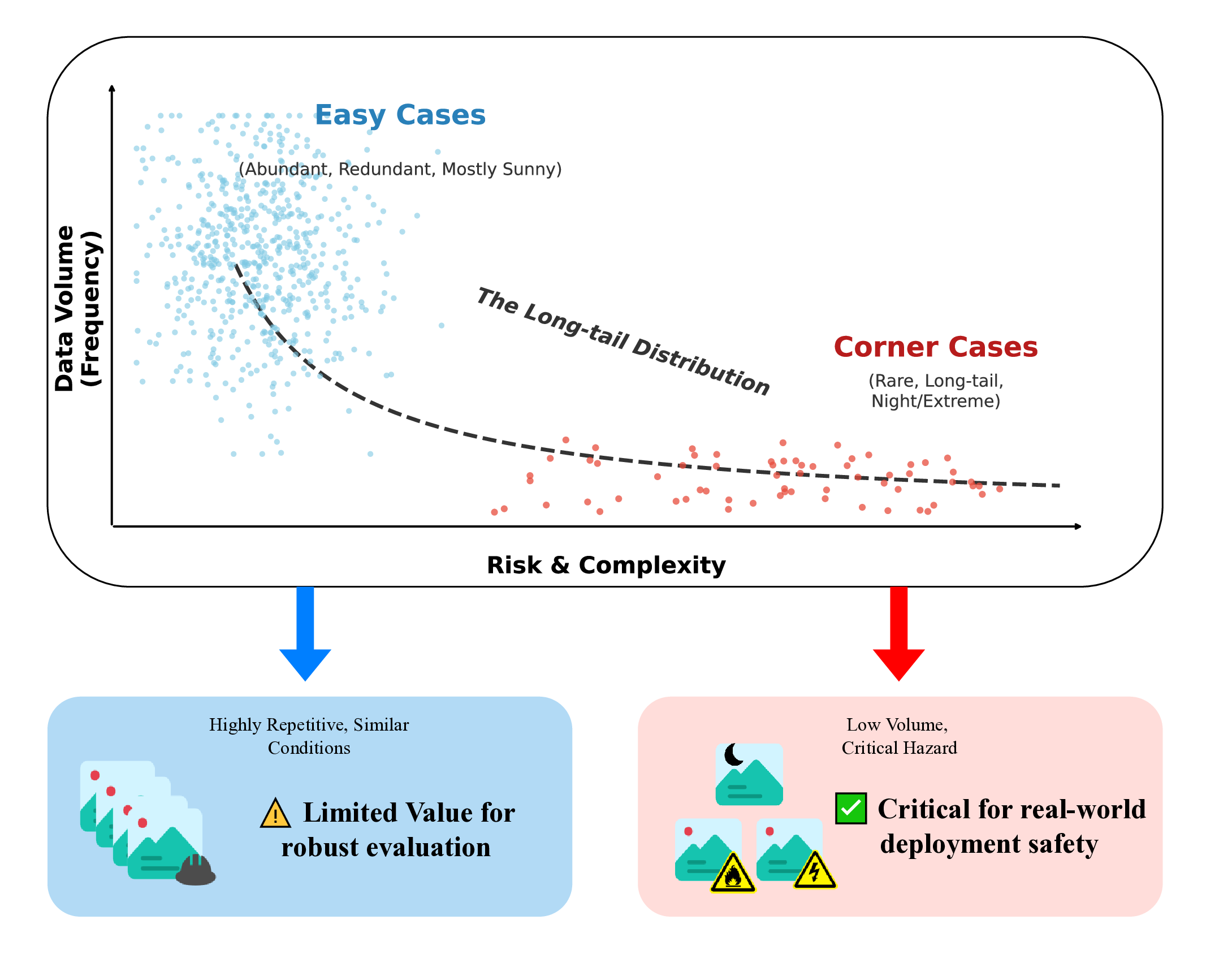
Construction-safety models must handle concrete deployment risks, such as workers near scaffold edges without guardrails, rather than only recognize common objects in curated images. Real inspection archives are redundant, long-tailed, and collected across changing sites and months.
SafeBuild-Bench is mined from 100K+ industrial image-text records and contains 3,314 task instances, each backed by its own expert-verified image. It covers multiple-choice hazard identification and free-form hazard description, while retaining temporal and site metadata for stratified robustness analysis.
The benchmark spans five collection months, July to November 2025, and every instance keeps its capture month. Month-stratified scores can therefore be reported alongside the aggregate number. Fixed models vary materially across those slices, which is the argument for reporting them; the released metadata supports that analysis rather than a strict forward-chaining or held-out-site protocol.
GEMS combines proxy-model confusion with graph-based diversity. The objective is not to auto-label hazards, but to surface a compact, non-duplicate review queue from redundant industrial streams.
Fuse image-text records into multimodal embeddings and connect nearby scenes through a sparse k-NN graph.
Use a proxy MLLM's normalized likelihood as a confusion score for potentially informative samples.
Apply a CELF-based submodular objective to balance high-value hazards against redundancy saturation.
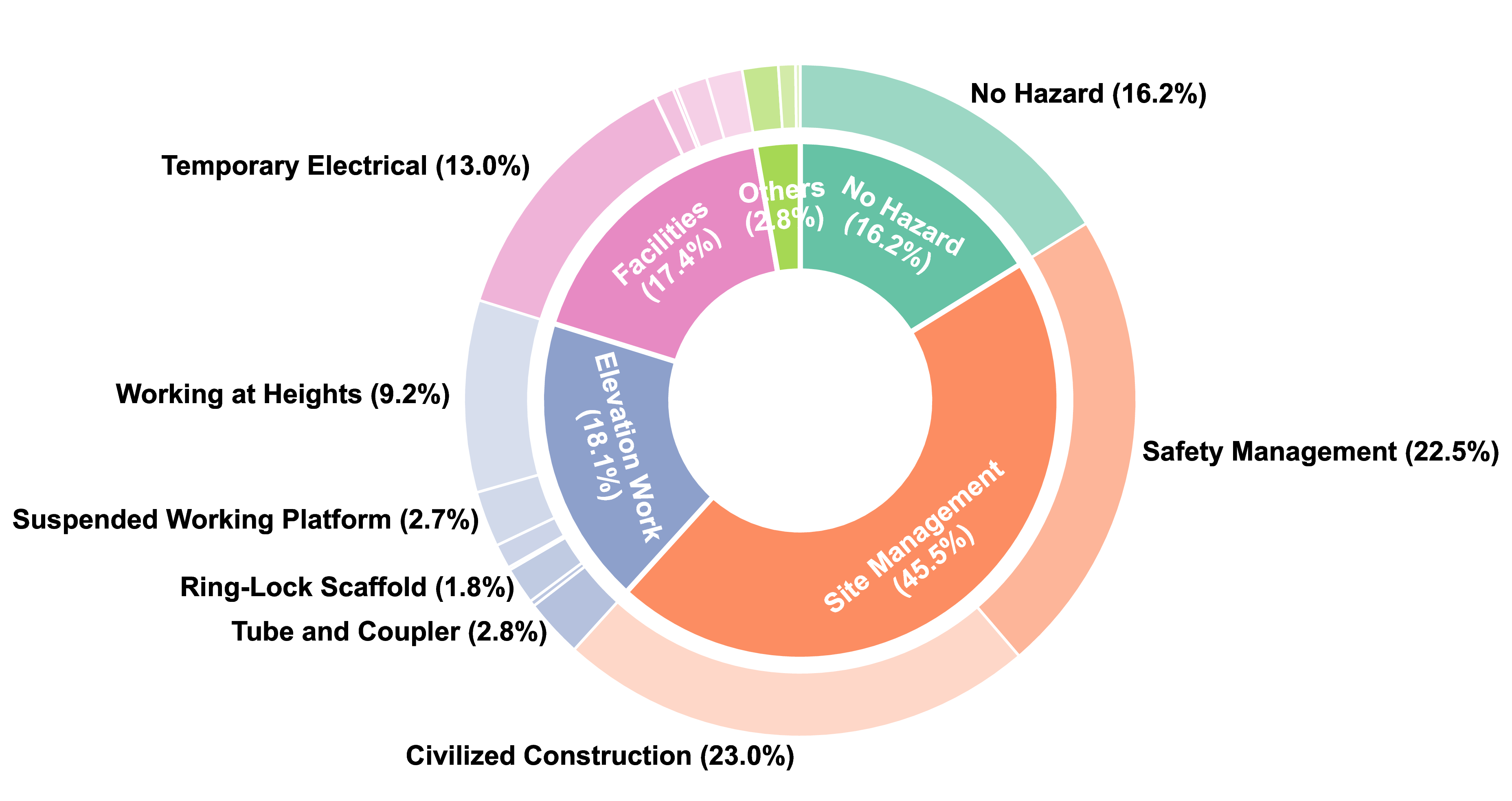
The benchmark keeps month and site metadata so evaluation can be reported as aggregate scores and as deployment-relevant slices.
2,200 instances
Multiple-choice questions ask models to select the primary hazard from visually and semantically similar categories.
1,114 instances
Free-form prompts evaluate whether models detect hazards and provide specific, grounded safety descriptions.
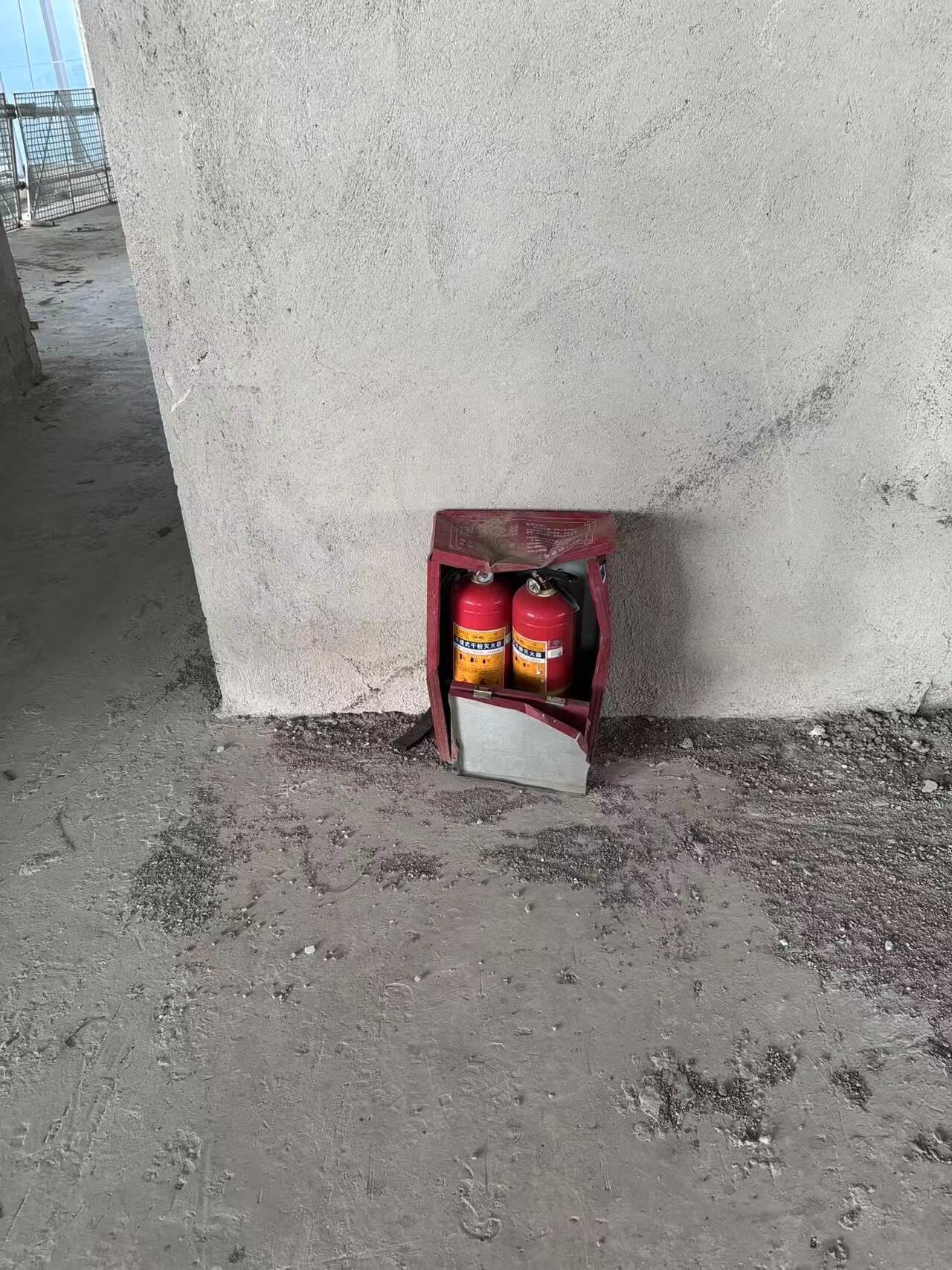
MCQ
The site is orderly, with fire extinguishers properly stored and accessible.
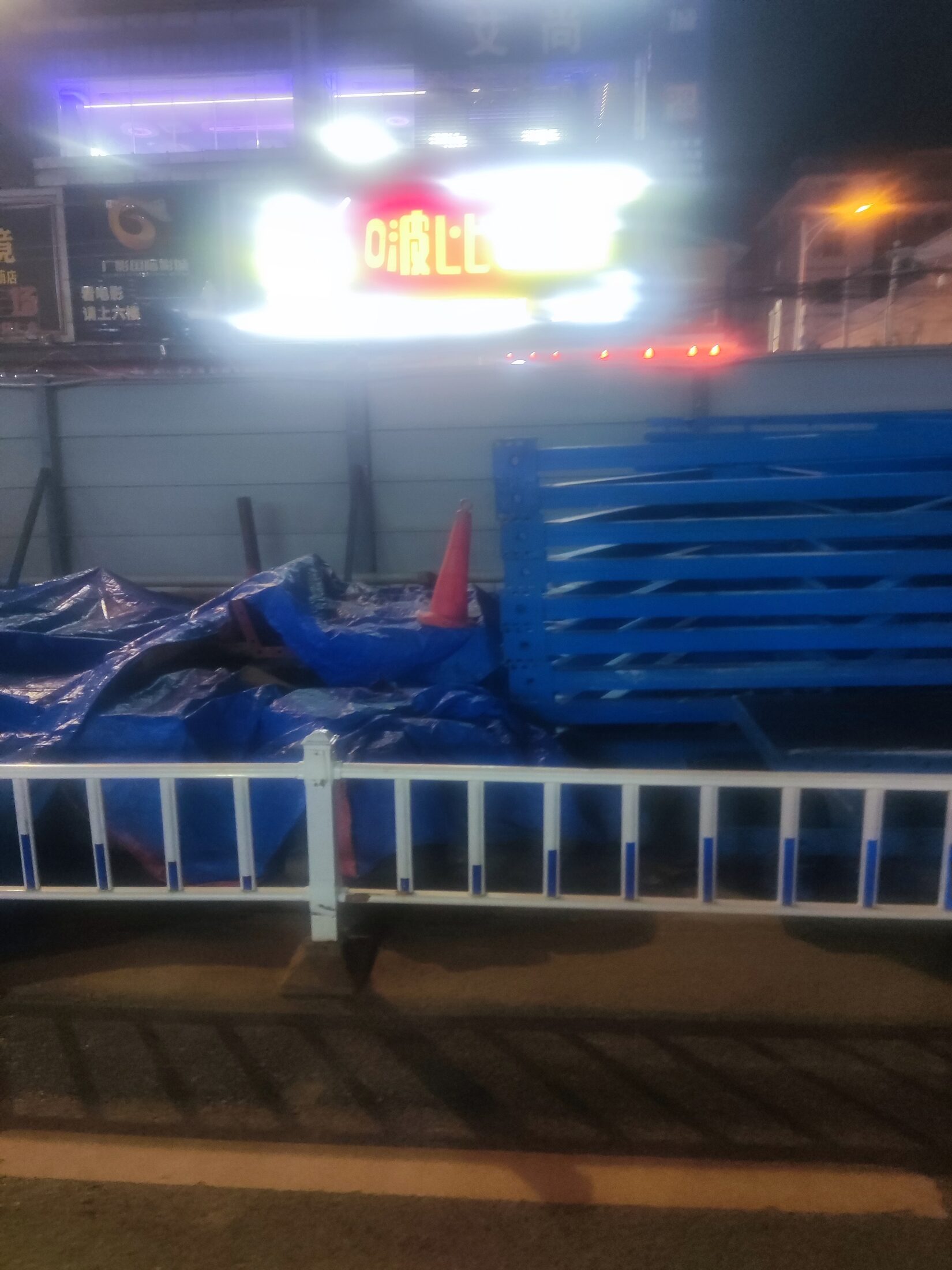
MCQ
The scene tests whether models notice missing warning signs and covered equipment risks.
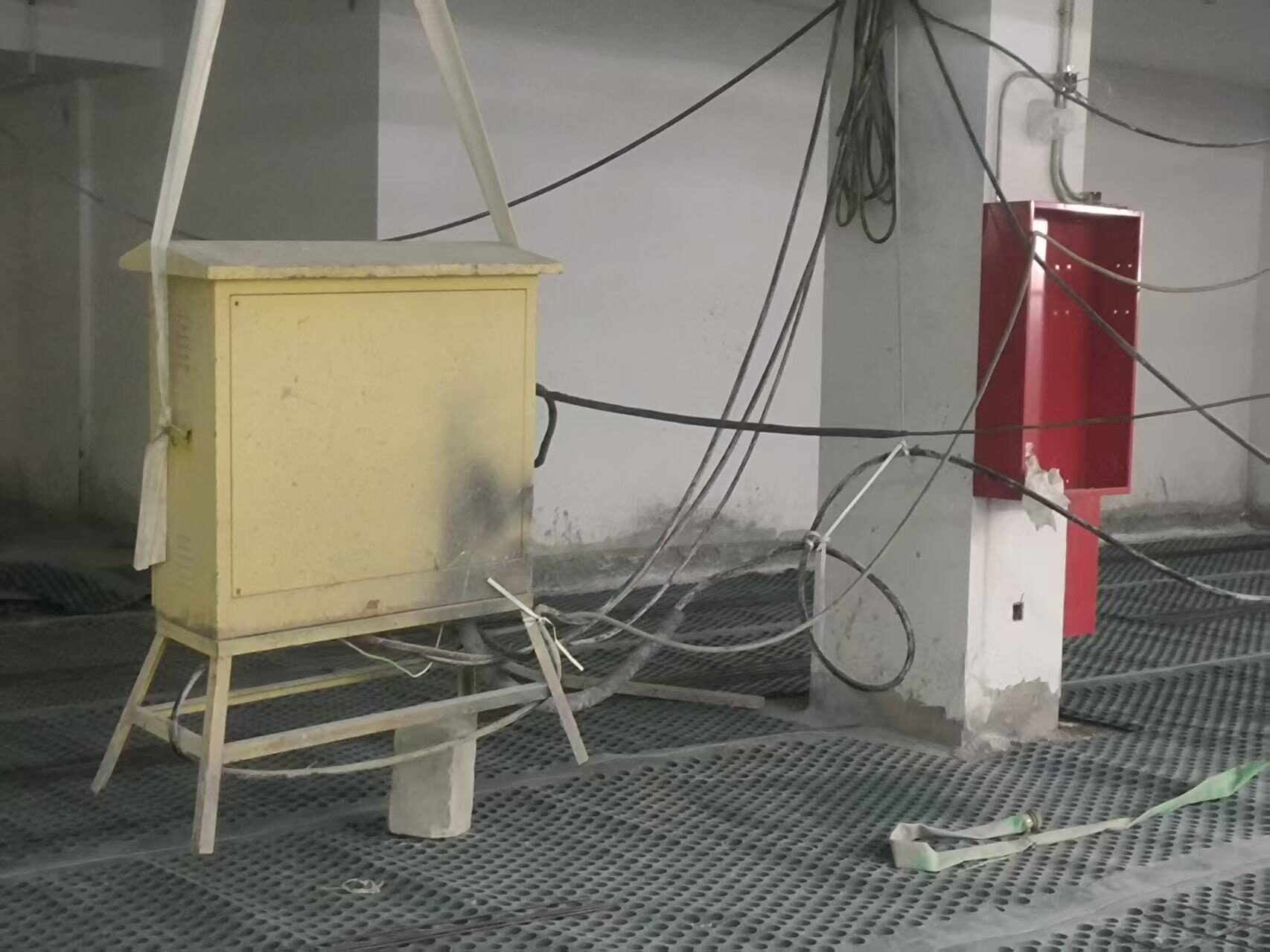
Description
A model can detect hazards but miss key reference objects needed for a high-quality explanation.
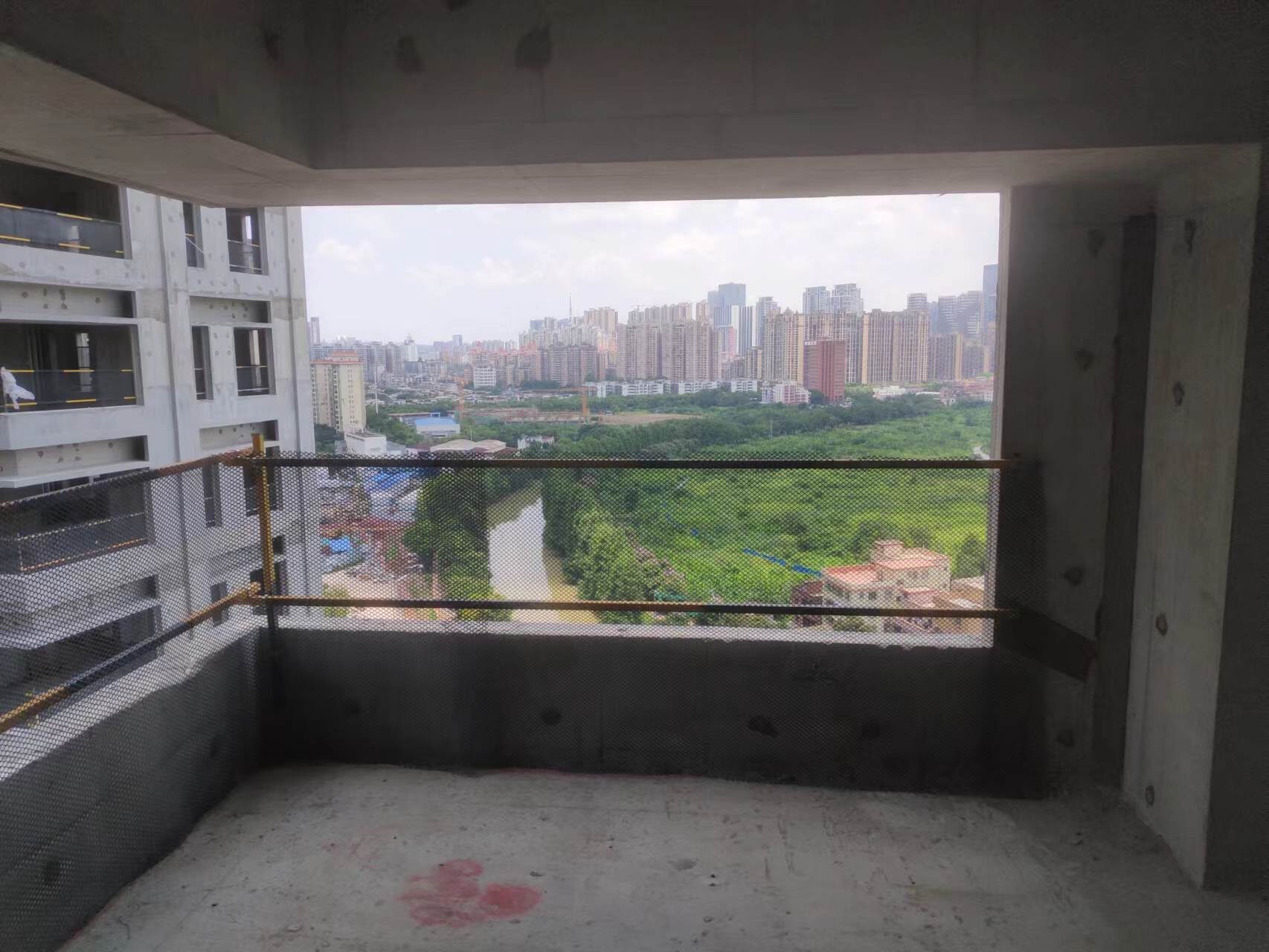
Description
The model incorrectly reports no visible hazard despite gaps in safety netting.
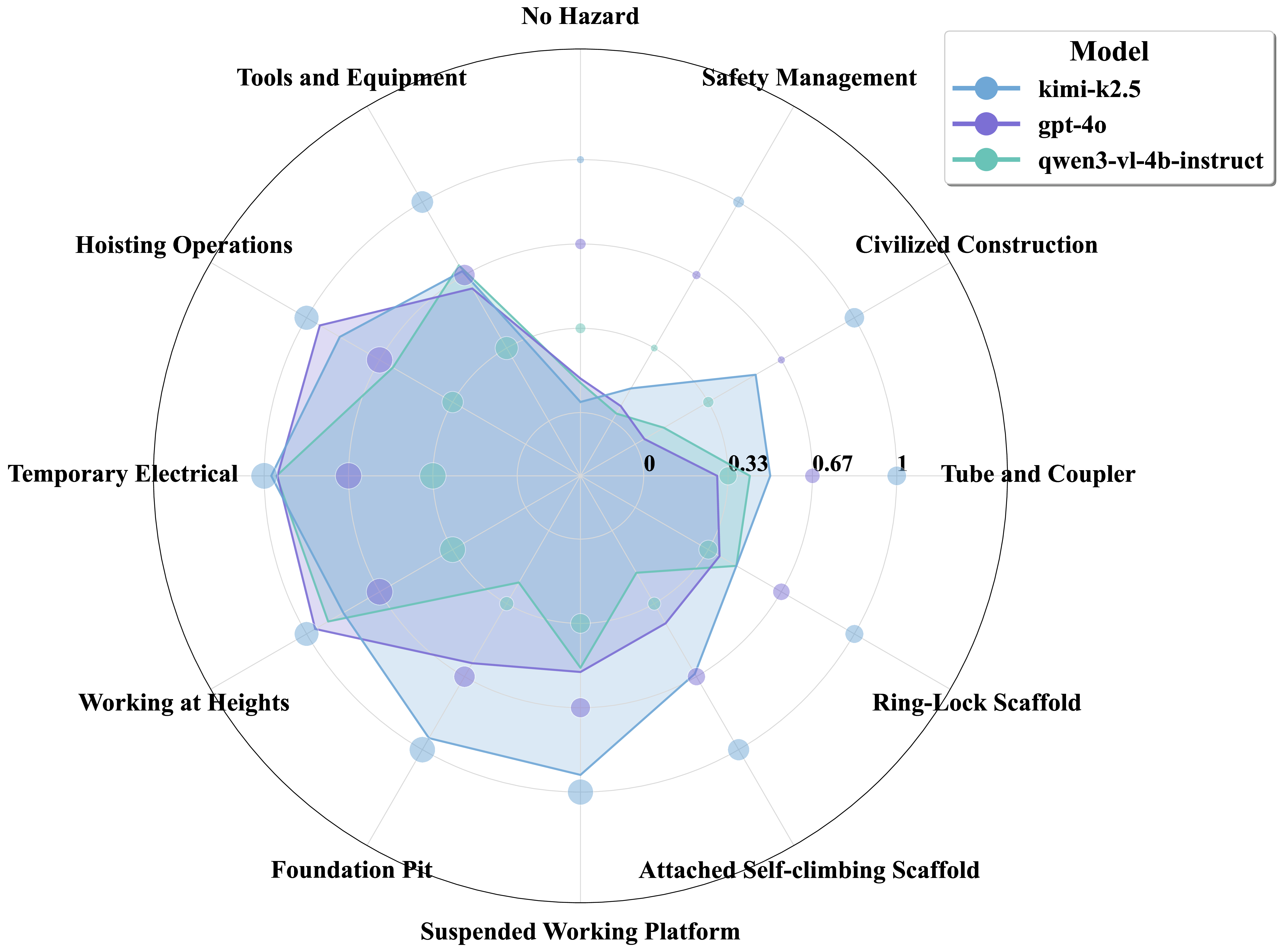
The best overall score is near 60, and strong models differ sharply across identification, description, and month-level slices.
| Model | Identification Acc. | Macro-Recall | HDR | Desc. Quality | Overall |
|---|---|---|---|---|---|
| Kimi-K2.5 | 48.7 | 67.7 | 72.6 | 53.7 | 60.7 |
| Gemini-3-Flash-Preview | 55.8 | 65.8 | 67.6 | 48.4 | 59.4 |
| Qwen3-VL-Plus | 40.3 | 53.7 | 79.9 | 62.5 | 59.1 |
| Claude-4.5-Sonnet | 48.3 | 56.2 | 64.4 | 50.6 | 54.9 |
| GPT-4o | 34.3 | 43.8 | 66.5 | 50.7 | 48.8 |
The dataset is released under CC BY 4.0. Instance IDs in the release match the evaluated sets behind the paper's tables exactly.
3,314 images with hazard categories, reference descriptions, judge criteria, capture month, and split labels. Hugging Face imagefolder layout.
Graph-enhanced mining for candidate selection from redundant multimodal inspection streams, plus the MCQ and description evaluation runners.
196 November description references were regenerated from their Chinese expert annotations after publication. The released data is corrected; the paper's description scores are not, and will not reproduce. Four instances remain unscorable and are listed in the patch file.
Safety-focused evaluation and improvement. Not for biometric identification, worker surveillance, or automated disciplinary decisions.
@inproceedings{cui2026safebuild,
  author    = {Cui, Yi and Wang, Zilin and Xu, Yijie and Cai, Qianyi and
               Yao, Huizai and Jiang, Shuai and Zhong, Bingzhuo and Xiong, Hui},
  title     = {SafeBuild-Bench: A Temporal-Robust Construction Safety Benchmark
               with Graph-Enhanced Data Mining},
  year      = {2026},
  isbn      = {979-8-4007-2259-2},
  publisher = {Association for Computing Machinery},
  address   = {New York, NY, USA},
  url       = {https://doi.org/10.1145/3770855.3817581},
  doi       = {10.1145/3770855.3817581},
  booktitle = {Proceedings of the 32nd ACM SIGKDD Conference on Knowledge
               Discovery and Data Mining V.2},
  numpages  = {12},
  location  = {Jeju Island, Republic of Korea},
  series    = {KDD 2026}
}
An open-access preprint is available at arXiv:2608.00068.